How to Find Guest Posting Sites (Free Methods That Actually Work)
If you’re trying to increase your website traffic, you’ve probably heard this advice before: “You need backlinks.” And one of the best ways to get those backlinks is through guest posting. But before you can write a single article, you run into your first real problem. You need to find guest posting sites that are actually worth your time.
Many beginners open Google, type in “write for us,” and end up with low-quality directories or spammy websites. This approach doesn’t help your SEO. In fact, it can hurt your site. So how do you find real, high-quality guest posting opportunities without paying for expensive tools?
This guide will walk you through several free methods that real SEO experts use every day. You’ll learn how to find good sites, avoid bad ones, and build backlinks that actually improve your rankings. Let’s get started.
Why Finding the Right Guest Posting Sites Matters
Before we jump into the methods, let’s talk about why this step is so important. Guest posting isn’t just about getting a link. It’s about getting the right link. One link from a relevant, trusted website can give you more value than dozens of links from low-quality sites.
Google views backlinks as a vote of confidence. When a reputable site links to you, Google sees it as a sign that your content is trustworthy. But if you collect links from spammy or irrelevant sites, Google may ignore them or even penalize you.
That’s why learning how to properly find guest posting sites is a valuable skill. The good news is that you don’t have to spend money on expensive SEO tools to do it. Free methods, when used correctly, can give you great results.
Start With Simple Google Search Operators
The most underrated tool for finding guest posting opportunities is Google itself. You just need to know what to type in. These are called search operators, and they help you find exactly what you’re looking for.
Try searching for these phrases:
- “write for us” + your niche
- “guest post” + your niche
- “contribute to” + your niche
- “become a contributor” + your niche
- “guest article” + your niche

For example, if you have a blog about gardening, you would search for:"write for us" gardening
If you want to exclude certain results, you can use the minus sign. For example:"guest post" marketing -"pitch" -"sponsored"
This helps filter out pages that are asking for payment or pitching services rather than offering genuine guest posting opportunities.
GP Publisher recommends spending at least 30 minutes per week on this type of research. Over time, you’ll build a customized list of websites that actually fit your niche. The key is to stay organized. Create a simple spreadsheet with columns for website name, contact email, and domain ranking.
Use Free SEO Tools to Check Site Quality
Once you find a site that accepts guest posts, you need to check if it’s worth your time. You don’t have to buy an expensive membership. Several free tools give you a good idea of the strength of the site.
Check Domain Rating (DR) and Domain Authority (DA)
Free tools like MozBar (a browser extension) or Ubersuggest let you see a site’s authority score. A higher score doesn’t always mean a better site, but it gives you a general idea. For most small to medium-sized websites, a DR of 20 to 40 is a good starting point.
Check Organic Traffic
A site can have high DR but very little traffic. That’s a red flag. Free versions of tools like SimilarWeb or the SEOQuake extension show you estimated monthly traffic. Look for sites with at least 1,000 to 2,000 monthly visitors. Those sites are active and have real readers.
Check for Real Engagement
Check out the blog posts yourself. Do they have comments? Are the articles shared on social media? A site with no engagement can still be useful, but it’s worth checking. GP Publisher always advises its users to look for signs of life before reaching out to any website.
Analyze Your Competitors’ Backlinks
This is one of the best free methods available. Your competitors have already done the hard work of finding guest posting sites. Why not learn from them?
Take a competitor in your niche and look at their backlinks. Free tools like Bing Webmaster Tools (yes, Bing offers this for free) or Small SEO Tools’ backlink checker will show you where your competitors are getting links from.
Make a list of these websites. Then visit each one and look for their guest posting guidelines. Many of these sites will accept guest posts from new writers, especially if you can write something valuable.
GP Publisher has helped hundreds of website owners use this proven method to build high-quality backlinks without spending months on manual research. The logic is simple. If a site links to your competitor, it will likely link to you too, as long as your content is good.
Search on Social Media Platforms
Social media isn’t just for memes and personal updates. It’s also a great place to find guest posting sites.
LinkedIn, in particular, has several groups dedicated to guest posting and content collaboration. Search for phrases like “guest post opportunities” or “bloggers wanted” within LinkedIn groups. Twitter (now X) is also useful. Try searching for:
“guest post” “your niche” or “guest posts wanted”
Facebook groups for bloggers and webmasters often have daily posts where site owners are asking for guest contributors. Join a few active groups and pay attention to the requests. But be careful. Some groups are filled with low-quality offers. Look for groups with real discussions and active moderation.
Check Niche-Specific Directories and Networks
While many general guest post directories are low quality, niche-specific ones can be very helpful. For example, if you are in the health niche, there are health blogger networks. If you are in tech, there are tech blogging communities.
How do you find these? Search for:"[your niche] guest post network"
or"[your niche] blogger directory"
These smaller communities often have higher standards than the big, spammy directories. The site owners in these networks know each other, and they care about quality.
Look for Broken Links on Relevant Sites
This method takes a little more effort, but it works great. Find a popular blog in your niche. Use a free broken link checker (many browser extensions do this) to find pages on that site that return a 404 error.
When you find a broken page that has backlinks pointing to it, you can email the site owner. Tell them about the broken link and suggest your article as a replacement. This is called the “broken link building” method, and it often leads to guest posting opportunities because you are genuinely helping the site owner fix something.
How to Spot Low-Quality or Spammy Guest Post Sites
As you learn how to find guest posting sites, you will also run into many low-quality options. Knowing what to avoid is just as important as knowing what to look for.
Here are clear warning signs:
- The site accepts every guest post without any editing or review.
- The site is filled with articles on unrelated topics like casino, pills, or payday loans.
- There is no real author information or “About Us” page.
- The site has a very low Domain Rating (under 10) and zero traffic.
- The site asks for payment but has no real audience.
Google’s spam policies are very clear about link schemes. If you collect too many backlinks from low-quality sites, Google can manually penalize your website. It is very difficult to get this penalty back.
GP Publisher always tells its clients that one good guest post on a real website is worth more than fifty posts on spam directories. Focus on quality, not quantity.
What to Do After You Find Guest Posting Sites
Finding sites is only half the battle. You also need to pitch your idea and write a great article. Here’s a simple process to follow.
Step 1: Read Their Guidelines
Each site has different rules. Some want a full article. Others just want a pitch. Follow their instructions exactly. If you don’t, they will ignore your email.
Step 2: Personalize Your Pitch
Don’t send the same email to fifty different sites. Mention something specific about their blog. Show that you actually read their content.
Step 3: Propose a Specific Topic
Don’t say, “I can write anything.” Say, “I’d like to write a guide for your readers on [specific topic] because I saw that you recently wrote about [related topic].”
Step 4: Write Your Best Content
Once they say yes, write the best article you can. Include examples, data, and clear explanations. Make the site proud to publish your work.
Step 5: Include a Natural Bio
Your author bio should include a link to your site. Don’t stuff the link with keywords. Use your name or your brand name. Keep it natural.
A Real-World Example to Guide You
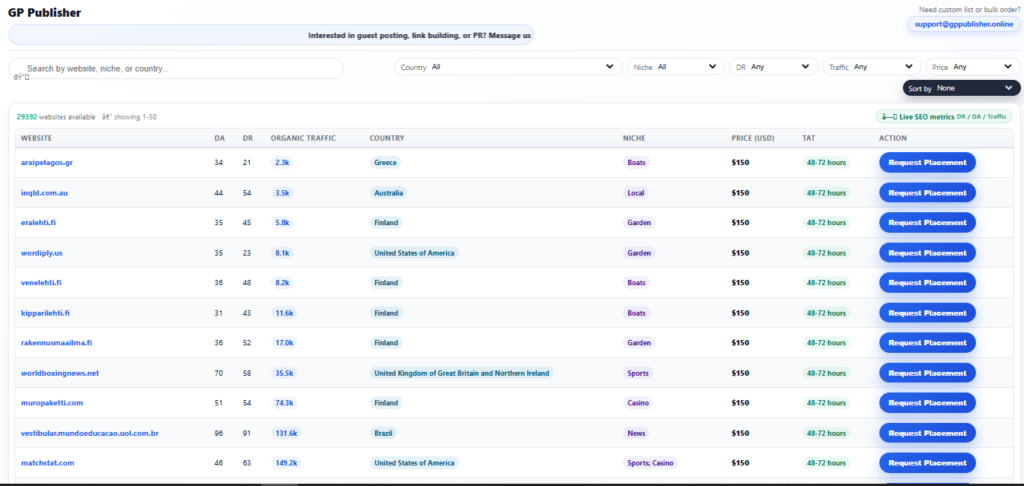
Let us say you run a small blog about boating. You want to find guest posting sites in the boating and marine niche. You search for "write for us" boating on Google. You find a site like arxipelagos.gr (similar to the example in the image above). You check its traffic and see it gets around 2,300 monthly visitors. Its DR is 21. That is a solid starting point.
Then you look at the types of articles they publish. You see that they like detailed guides and gear reviews. You come up with a topic like “Five Common Boating Mistakes Beginners Make.” They accept. You write a useful article with original insight. They publish it with a link to your blog. That’s how guest posting should work.
GP Publisher has a curated network of websites like this in many locations. You can explore options at GPPublisher.online to save time and find trusted sites quickly.
How to Track Your Guest Posting Results
Once you start publishing guest posts, you need to track their impact. Here’s what to monitor.
- Referral Traffic: Check Google Analytics to see if visitors are clicking from the guest post to your site.
- Keyword Rankings: Over time, your target keywords should start moving up in search results.
- Domain Authority: Your overall site authority should slowly increase as you earn quality backlinks.
Don’t expect overnight results. SEO is a long-term game. But if you consistently publish guest posts on good sites, you’ll see real growth within three to six months.
Common Mistakes to Avoid When Finding Guest Posting Sites
Many website owners make the same mistakes when they start guest posting. Avoid these mistakes to save yourself time and frustration.
Mistake 1: Only Looking for High DR Sites
A site with a DR of 80 may seem perfect, but it can also be very difficult to get a post accepted. Medium-sized sites (DR 20 to 40) are often easier to work with and still pass along valuable link equity.
Mistake 2: Ignoring Relevance
Getting a link from a high-traffic cooking blog doesn’t help your fishing website. Google looks at relevance. Stay in your niche.
Mistake 3: Sending Generic Pitches
“Dear webmaster, I want to write for you.” This type of email gets deleted immediately. Take the time to personalize each pitch.
Mistake 4: Forgetting to Follow Up
Site owners are busy. If you don’t hear back in a week, send a polite follow-up email. Many opportunities come from the second or third email.
Final Thoughts and Actionable Takeaways
Learning how to find guest posting sites is one of the most valuable skills you can develop as a website owner. It takes patience and consistent effort, but the rewards are real. Higher rankings. More traffic. A stronger reputation in your niche.
To summarize, here is your action plan:
- Use Google search operators to find potential sites.
- Check each site’s authority and traffic using free tools.
- Analyze your competitors’ backlinks for hidden opportunities.
- Search social media groups and niche directories.
- Avoid low-quality and spammy sites at all costs.
- Personalize every pitch and write your best content.
- Track your results and adjust your approach over time.
GP Publisher is here to make this whole process easier for website owners who want to save time without sacrificing quality. Whether you’re just starting out or you’ve been doing SEO for years, having a reliable way to find genuine guest posting sites changes everything.
You can explore a handpicked selection of websites across dozens of niches at GPPublisher.online/GP-Publisher-Website-Network.html. Take a look at the screenshot below for a preview of what kind of data and transparency you can expect. That level of detail helps you make informed decisions about where to invest your time and energy.
Now it’s your turn. Pick a method from this guide and try it today. Find a good site. Write a great pitch. Get a quality backlink. Small steps, repeated consistently, lead to big results. Good luck.
Previous articles:
[…] Find Guest Posting Sites: Free SEO Guide | GP Publisher High Quality Backlinks: What I Learned After 200+ Failures How to Start Guest Posting: Step-by-Step Guide for Success ←Find Guest Posting Sites: Free SEO Guide | GP Publisher […]